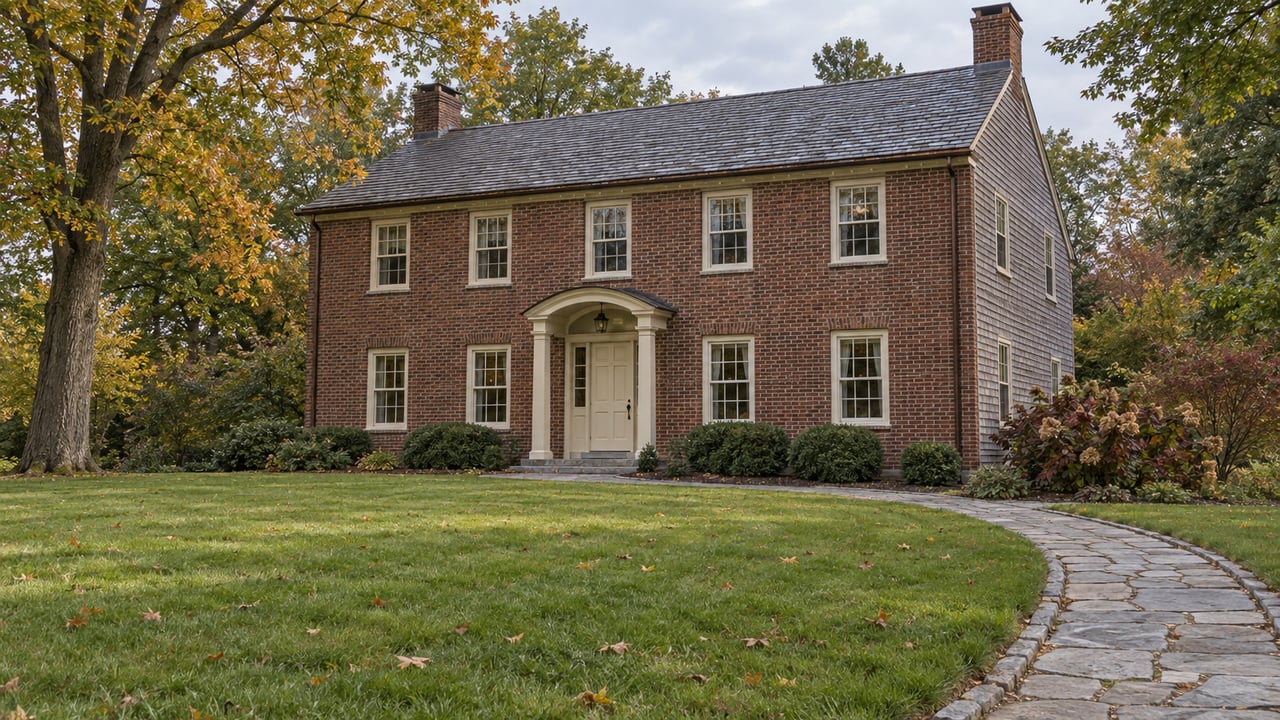
Weston's best-documented modern neighborhood gets no demolition review. Kendal Common's houses went up between 1950 and 1957. Weston's demolition delay bylaw covers buildings that existed on January 1, 1945, or whose age can't be determined. So the houses Massachusetts already considers historically significant are the ones the town has the least power to slow down.
A volunteer committee is drafting a fix. The Weston committee's October 1 agenda lists the proposal as a discussion item: a local historic district that owners would join one property at a time. If you're buying or renovating here, you're dealing with a gap that has a draft fix but no vote yet.
The Line the Town Drew
Weston's 2024 modern-architecture survey states it directly. Most of the town's historic property inventory forms cover buildings from before 1945, and the demolition delay bylaw only applies to buildings from that period. For older houses, the Weston Historical Commission can find a building "preferably preserved," and that finding triggers a 12-month delay before demolition.
A 1951 Carl Koch house gets none of that. Alicia Primer sits on both the Kendal Common and Crescent Street committees, and she told the Weston Observer in November 2025:
"The Historical Commission can't even impose any delay at all – nothing can be done – so, we came up with the idea of a local historic district, such as they have at Crescent Street."
Primer also pointed out the mismatch with state practice. The Massachusetts Historical Commission treats resources more than 50 years old as historic, which she put at anything built before 1975 when she spoke in late 2025.
What Sits Outside the Line
The Observer counts 22 homes at Kendal Common. The neighborhood lies off Lexington Street and runs over the line into Waltham. The Observer calls it a cooperative-style neighborhood, and owners share common land. The Weston Historical Society's account lists the architects as Carl Koch, Robert Woods Kennedy, Walter F. Bogner, Carleton R. Richmond Jr., Hugh Stubbins and The Architects Collaborative. Rick Brotman lives in a 1951 Koch house and sits on the study committee. He described the area as a testing ground for Koch's much larger Conantum neighborhood in Concord. His own house has radiant heat in the concrete slab, and another house nearby has it in the ceiling.
These houses aren't obscure. In 2003, the Massachusetts Historical Commission issued an Opinion of Eligibility for the National Register covering the Kendal Common Area. It named 17 addresses on Ellis Road, French Road, Kendal Common Road and North Avenue. National Register status doesn't bring local demolition review, though, and the 1945 bylaw doesn't reach these houses either.
The Fix Is an Opt-In
The committee chose not to write a new bylaw. It is amending Weston's existing Crescent Street Historic District bylaw, which voters adopted in 1993, to add Kendal Common. In November 2025, the committee voted unanimously for two separate Historic District Committees. In July 2026, it said each district would have its own section in the bylaw.
The biggest design choice came out at the March 5, 2026 meeting. A resident asked whether inclusion was mandatory. The Weston committee's March 5, 2026 minutes record Primer's answer that participation is voluntary on a property-by-property basis. The Weston committee's January 23, 2025 minutes also record her confirmation that the amendment can list specific properties and doesn't need to include every Kendal Common home.
The shared land is out. In June 2026, the Massachusetts Historical Commission told the committee it couldn't fold the common land into the bylaw, because landscape features aren't part of an architectural resource to protect. The district, if voters approve it, would exclude the shared land.
Because of the opt-in, the rules can differ from one lot to the next. Two houses by the same architect on the same street could end up under different rules, depending on what each owner decided before the vote.
What Review Would Actually Touch
The Kendal Common guidelines are still a draft, so the closest reference is the Crescent Street bylaw the committee is building on. Under that text, no exterior feature visible from the street can be built or altered without a certificate from the commission. A building permit or demolition permit can't be issued until the certificate is in hand.
| Under the Crescent Street bylaw | How it's handled |
|---|---|
| Exterior features visible from the street, such as siding, windows, doors and additions | Needs a certificate |
| Additions and new construction | Reviewed for size and shape. The commission may set extra setbacks |
| Interiors and features not visible from the street | Not reviewed |
| Exterior paint and roof colors | Exempt |
| Storm doors and windows, screens, window air conditioners | Exempt |
| Terraces, walks and driveways at grade | Exempt |
| Plantings and landscaping | Exempt |
| Ordinary repair with no change in design or material | Exempt |
| Filing fee | $20 or one-tenth of one percent of the exterior project cost, whichever is higher |
| Decision deadline | 45 days. If the commission doesn't decide, it must issue a certificate of hardship |
Kendal Common residents asked about this table at the March meeting. Stephen Maire objected to the fee and to the 45-day review period. Primer said 45 days is the legal maximum. Others asked whether being visible from more than one street would widen review, and who would impose fines. One resident worried that historically exact window replacements would drive up costs. Henry Stone agreed that exact replication is often too expensive for this architecture. David Fixler said the guidelines allow reasonable alternatives, and that minor applications could be approved administratively. Fixler has also said solar panels are reversible, and that owners are now encouraged to install them.
Several of those questions are still listed as needing clarification with Town Counsel, so none of this is final.
Why November 23 Looks Out of Reach
The committee first aimed for the May 2026 Town Meeting, then moved its target to the fall Special Town Meeting. That meeting is set for November 23, and warrant articles are due October 9. Massachusetts General Laws chapter 40C sets out the order of steps:
- The committee prepares a report on the significance of the buildings and sends it to the Planning Board and the Massachusetts Historical Commission.
- At least 60 days after sending it, the committee holds a public hearing, with notice mailed to owners at least 14 days ahead.
- The committee then submits a final report, a map and a draft bylaw to Town Meeting.
- Town Meeting must approve by a two-thirds vote.
We haven't found any posted record that the report has been sent or that a hearing has been noticed. September agendas for the Historical Commission and Select Board don't mention Kendal Common. If the report went out today, the earliest legal hearing date would be November 29, six days after Town Meeting. A filing that was never posted online could change that. Going by the public record, though, a later Town Meeting looks more realistic.
The vote threshold doesn't line up either. The January 2025 committee minutes say a simple majority is needed. The statute requires two-thirds, both to create a district and to amend a bylaw that creates one.
Where the Gap Shows Up in a Sale
At the July 23, 2026 meeting, Brotman said buyers were looking at a house next to the neighborhood, and that its future was unknown. The committee planned to send a memo about the neighborhood to the property's representative. It also discussed a preservation deed restriction, which would require an appraisal paid for with Community Preservation Act funds. That house shows the gap clearly. An outside buyer has no review to go through today. The tools being discussed are voluntary ones, like a letter and a deed restriction the property's representative would have to agree to.
The neighborhood itself has held steady. In October 2025, Brotman said 30% or more of the houses had been renovated. He said recent sales had made the neighborhood feel urgent about protection, but that feeling had eased as things settled. He told the Observer that new owners had updated and repaired their houses while keeping their essential character. Those renovations happened without a district in place.
If you're writing an offer here, three questions come straight out of the record. Will the seller opt in before a vote? Does any planned exterior work, such as windows, siding or an addition, depend on rules still in draft? Is there a deed restriction or other covenant on title? The Crescent Street bylaw tells its commission to consider existing deed restrictions too.
Questions Buyers Ask
Can I tear down a Kendal Common house today? Weston's demolition delay doesn't apply, because the bylaw stops at 1945 and no local historic district exists here yet. Other permits still apply as usual.
Would joining the district be required? As discussed above, the March 2026 draft makes joining voluntary for each property. The bylaw isn't final.
Where can I hear the case directly? On October 29, 2026, David Fixler will speak on "The Modern House in Weston" at the Weston Historical Society annual meeting in the Weston Public Library Community Room. The meeting starts at 7:00, and the lecture follows at 7:30.
If you're weighing a Kendal Common house or any postwar modern in Weston, The Lara and Chelsea Collaborative can follow the district's progress with you and fold the open questions into your offer. Request a Private Consultation before you commit to a renovation plan.
This article is general information, not legal, tax or financial advice. Consult a qualified professional about your situation.